lizhiyao/oh-my-knowledge
oh-my-knowledge
OMK — Evidence-backed evaluation and observability for prompts, RAG, skills, agents, and workflows. Native Codex, Claude Code, and DeepSeek Harness support.
Install
npx @deepseek-ai/dsh plugin --profile web add oh-my-knowledgeRestart `dsh web` after install. Bundle APIs can change during the developer preview.
README badge

[](https://dshhub.dev/plugins/oh-my-knowledge)Paste this into your README. The star count updates with every catalog sync.
From the README
Excerpt from lizhiyao/oh-my-knowledge, cleaned of badges and images.
OMK
English | 简体中文
Observe. Measure. Know.
OMK makes every knowledge change in your AI application evidence-backed.
Observe real-world performance, measure version differences, and determine whether the change is effective and the version is ready to ship.
Same model. Same evaluation samples. Only the knowledge artifact changes.
DeepSeek Harness users: install OMK as a native bundle, reuse the current profile for controlled evaluations, and open persisted DSH task trajectories in Studio. Set up the DSH host plugin →
📖 Full documentation: oh-my-knowledge.pages.dev (searchable, English / 简体中文)
What OMK helps you know
| Decision | Command | Evidence you get |
|---|---|---|
| Is this artifact coherent enough to evaluate? | omk doctor | structure, dependencies, safety, and measurability checks |
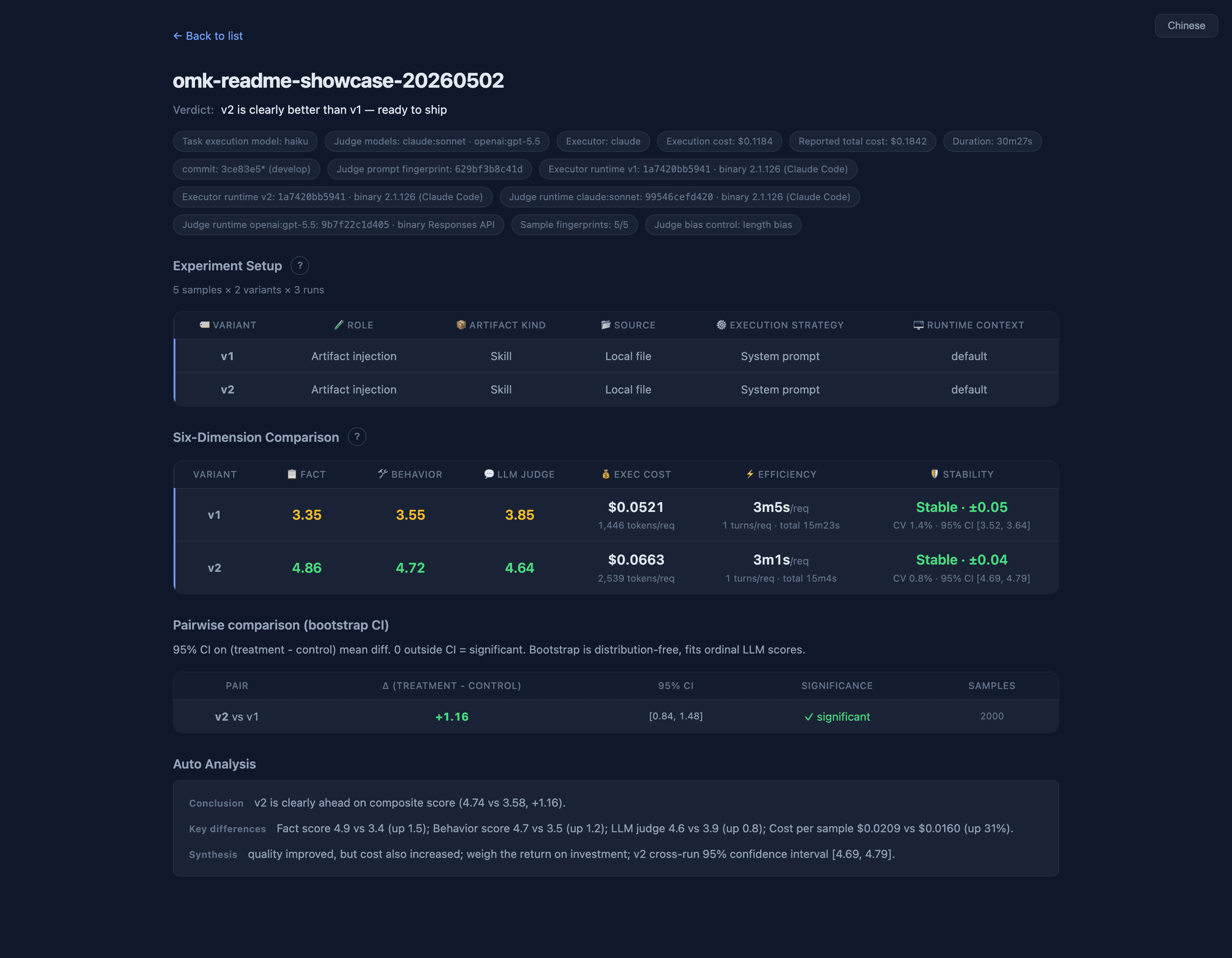
| Is v2 actually better than v1? | omk eval | one-line verdict, confidence interval, failed samples, cost |
| Why did it pass or fail? | omk studio | report view with scores, diagnostics, and examples |
| Should this version become the accepted one? | omk promote / omk evolve | evidence-gated accept or generate a better candidate |
| What happened during one real AI task? | omk observe / Studio Task Trajectory | a trace-backed view of the request, visible Knowledge, tool calls, results, response, and user correction |
| What did real usage expose? | omk observe / omk sample --from-traces | production gaps drafted for review; reviewed drafts can become eval samples |
Quick start
npm i -g oh-my-knowledge
omk init demo && cd demo
omk eval --control code-review-v1 --treatment code-review-v2 --dry-run
omk eval --control code-review-v1 --treatment code-review-v2
Runs out of the box — no edits needed first. omk init scaffolds two skill variants and three sample cases; --dry-run previews calls and cost; omk eval runs the controlled A/B and opens an HTML report with a one-line verdict in about five minutes. Once it runs, swap in your own skills and cases.
Prerequisite: configure one authenticated model runtime (Codex CLI, Claude Code, or an API executor; see Requirements). Inside a Codex task in the ChatGPT desktop app, omk automatically selects codex, reads the model from ~/.codex/config.toml, and uses the same Codex model as the default judge. Claude is not required.
To make Codex the default in regular terminals, add the preference to your shell profile (for example ~/.zshrc):
export OMK_EXECUTOR=codex
# Optional: export OMK_MODEL="your-codex-model"
Without OMK_MODEL, omk reads the model from ~/.codex/config.toml. You can still pass --executor codex --model <codex-model> per command. Pass --judge-models or set OMK_JUDGE_MODELS only when you want a different judge.
The first run has only 3 cases, so the verdict will usually be
UNDERPOWERED(insufficient data) — that's a normal starting point, not an error; grow to ~20+ cases before trusting a ship/no-ship call.
The CLI notifies you when a newer version is available (at most once per 20h); set
OMK_SKIP_UPDATE_CHECK=1to silence it permanently.
…