omdsh-dev/dsh-at-file
dsh-at-file
Codex-style @file mentions. Search workspace files in the composer and attach their contents to the prompt. Host plus Web client bundle.
Install
npx @deepseek-ai/dsh plugin --profile web add github:omdsh-dev/dsh-at-fileRestart `dsh web` after install. Bundle APIs can change during the developer preview.
README badge

[](https://dshhub.dev/plugins/dsh-at-file)Paste this into your README. The star count updates with every catalog sync.
From the README
Excerpt from omdsh-dev/dsh-at-file, cleaned of badges and images.
dsh-at-file
[!IMPORTANT] The latest official DeepSeek Harness release now includes built-in
@fileand@sessionreference features. Prefer the official implementation for new installations. This plugin remains available for existing setups and will be maintained occasionally on a best-effort basis.
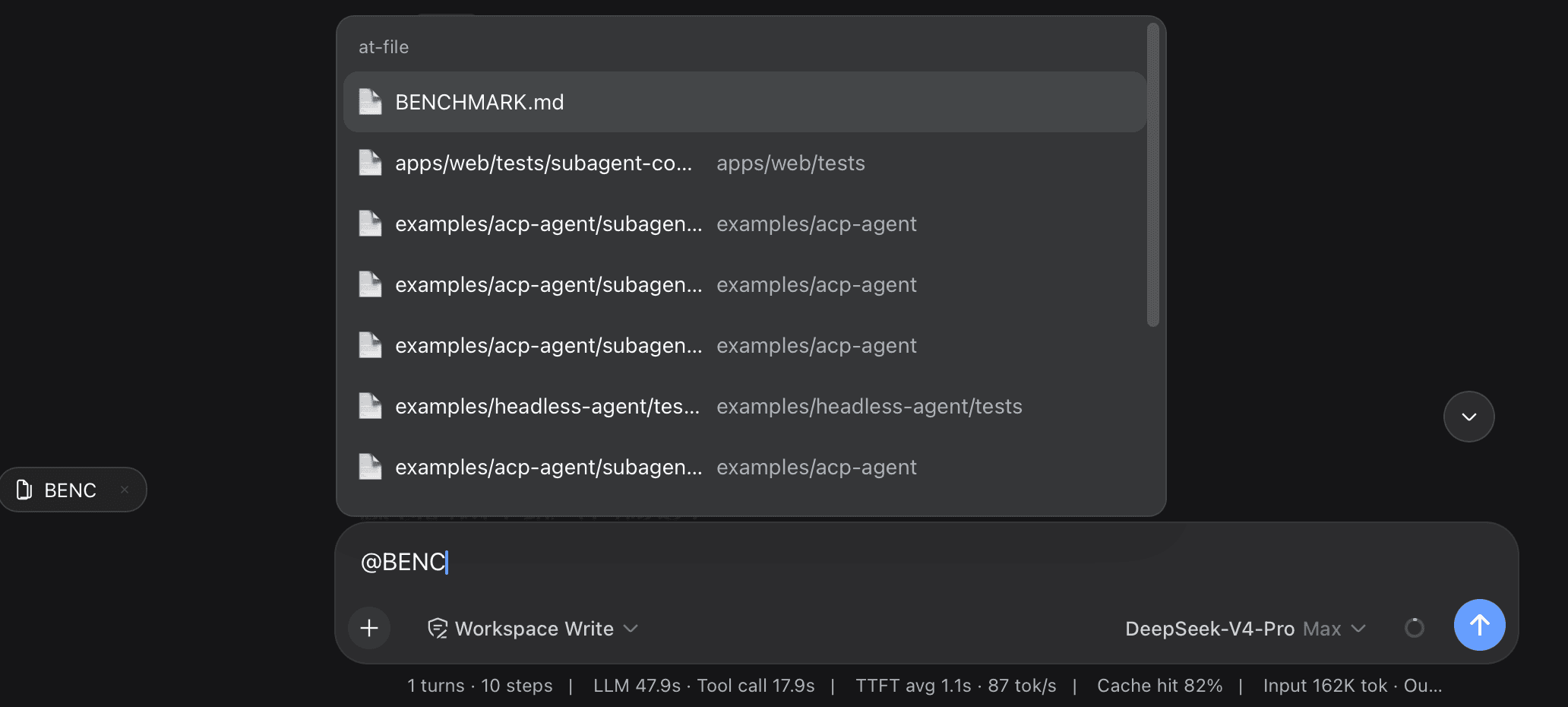
Workspace path references for the DeepSeek Harness web interface. Type @ in the composer to search the current workspace and insert a file or directory path.
Usage
Choose a result from the @ menu. The selected path remains visible in the draft and can be opened or removed from the reference bar.
Review @docs/spec.pdf
Before the agent starts a step, the plugin confirms that the path exists inside the active workspace. It then adds a short reference message:
<workspace-reference path="docs/spec.pdf" kind="file" />
The reference contains the workspace-relative path and its kind. The plugin does not open the referenced file or list the contents of a referenced directory. The agent can inspect the path with the tools available in the current session when the task requires it.
Pasted text is treated as ordinary text by default. An @path copied from another application does not open the picker, appear in the reference bar, or create a workspace-reference marker. Turn off Ignore @ mentions in pasted text in Settings -> File mentions if you need the older behavior.
File format and file size do not change this behavior. A PDF follows the same path-reference flow as any other workspace file.
This mechanism applies to version 0.3.0 and later. Earlier releases read file content during submission and enforced file-size limits.
Path Picker
Plain queries match filenames. Exact names, prefixes, and compact matches rank ahead of looser results, without matching letters scattered across a long directory path.
With an empty query, shallow paths appear before deeper entries; directories appear before files at the same depth. The scrollable menu exposes up to 50 candidates, so root-level files are not displaced by deeply nested directories.
A query containing / matches path segments in order. For example, src/view can find src/client/view.ts. A trailing slash such as src/ searches within that path.
When a directory is highlighted, press ArrowRight to enter it. The draft advances to @path/ without a trailing space, and the candidate menu stays open for the next selection. Enter and pointer selection keep the existing behavior and finish the directory reference.
Each result shows the complete filename first and its parent directory underneath. The menu expands to its 537px design width when space permits, and long filenames wrap instead of being ellipsized. Duplicate filenames also include the parent directory in the main label. Built-in SVG icons distinguish folders, source files, text, PDFs, images, data and configuration files, archives, and other files.
The default index skips common version-control directories, IDE metadata, dependency trees, caches, and build output. The list covers VS Code, Visual Studio, JetBrains IDEs, Fleet, Eclipse, Android and Gradle, Xcode, CMake, Flutter, .NET, Unity, Unreal, and common JavaScript and Python output directories. OS metadata files named desktop.ini, Thumbs.db, and .DS_Store are excluded by default.
Install or Update
…