ZSeven-W/dsh-android
dsh-android
DeepSeek Harness plugin for Android — build, run, and interact with a live emulator or USB device stream inside a conversation, driven entirely through adb.
Install
npx @deepseek-ai/dsh plugin --profile web add @zseven-w/dsh-android@latestRestart `dsh web` after install. Bundle APIs can change during the developer preview.
README badge

[](https://dshhub.dev/plugins/dsh-android)Paste this into your README. The star count updates with every catalog sync.
From the README
Excerpt from ZSeven-W/dsh-android, cleaned of badges and images.
<strong>A live Android device inside a <a href="https://github.com/deepseek-ai/deepseek-harness">DeepSeek Harness</a> conversation — emulator or USB phone, driven entirely through adb.</strong><br /> <sub>20 agent tools • in-process live stream, no external helper • three-button navigation panel • Gradle build & run • Vision OCR</sub>
<sub>npm: <code>@zseven-w/dsh-android</code> · Current plugin release: <code>0.1.0-rc.4</code> · Tested with DSH <code>0.1.1-rc.1</code></sub>
<b>English</b> · <a href="./README.zh.md">简体中文</a> · <a href="./README.zh-TW.md">繁體中文</a> · <a href="./README.ja.md">日本語</a> · <a href="./README.ko.md">한국어</a> · <a href="./README.fr.md">Français</a> · <a href="./README.es.md">Español</a> · <a href="./README.de.md">Deutsch</a> · <a href="./README.pt.md">Português</a> · <a href="./README.ru.md">Русский</a> · <a href="./README.hi.md">हिन्दी</a> · <a href="./README.tr.md">Türkçe</a> · <a href="./README.th.md">ไทย</a> · <a href="./README.vi.md">Tiếng Việt</a> · <a href="./README.id.md">Bahasa Indonesia</a>
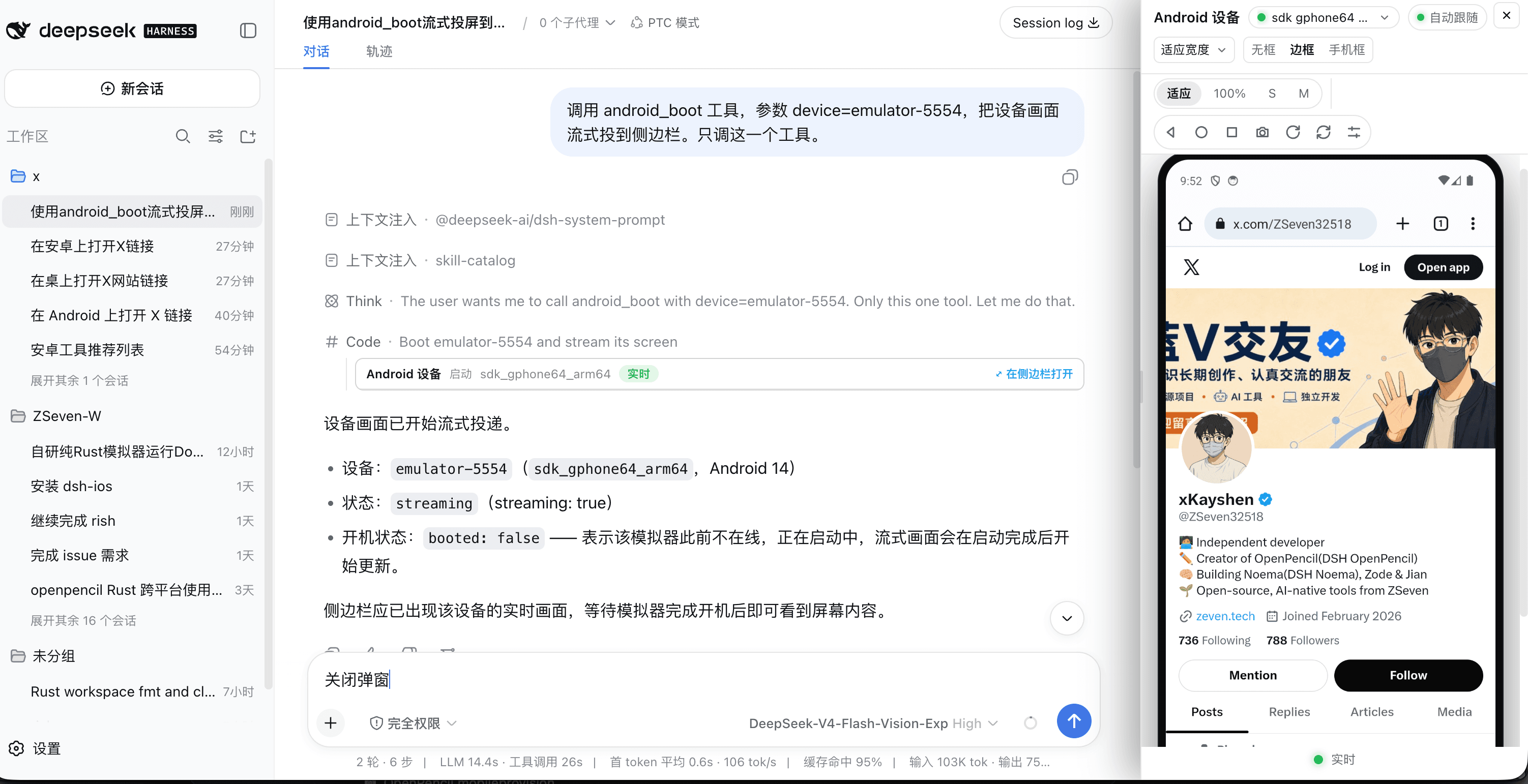
<br /> <p align="center"><sub>An Android device streamed and controlled from inside a DSH conversation — the agent's tool call in the center, the live device panel on the right</sub></p>Why DSH Android
DSH Android gives the agent a real Android device inside the conversation — and gives you the pixels. The agent can start a stream on an emulator or a USB-connected phone, build and install a Gradle project, drive the UI by resource-id/text or by OCR, read logcat, and inspect processes and memory, while a live stream of the device renders in a persistent sidebar panel where you can tap, drag, rotate, and press Back / Home / Recents directly on the video. No image blocks and no screen-recording files: visual bytes reach the UI only through signed, expiring URLs served by the DSH webserver.
There is exactly one code path. adb devices -l reports a serial, and that serial is a device's only identity — emulator-5554, a USB serial, or an ip:port target all behave identically. The plugin is bound to no emulator product (AVD, Genymotion, WSA, a cloud device farm), and there is no simulator/real-device split to reason about.
…