Clearailhc/clearai-dsh
clearai-dsh
ClearAI is a native DSH plugin that brings the Epistemic Loop to DeepSeek Harness.
Install
npx @deepseek-ai/dsh plugin --profile web add clearai-dshRestart `dsh web` after install. Bundle APIs can change during the developer preview.
README badge

[](https://dshhub.dev/plugins/clearai-dsh)Paste this into your README. The star count updates with every catalog sync.
From the README
Excerpt from Clearailhc/clearai-dsh, cleaned of badges and images.
Your research, grown into an ontology.
ClearAI is an ontology discovery and exploration platform, built on two core concepts:
- Domain ontology (what you get) — your project's own vocabulary, the knowledge entries established through the loop, and their graphs. At the end of a research session you hold a continuously growing knowledge structure, retrievable next round by concept.
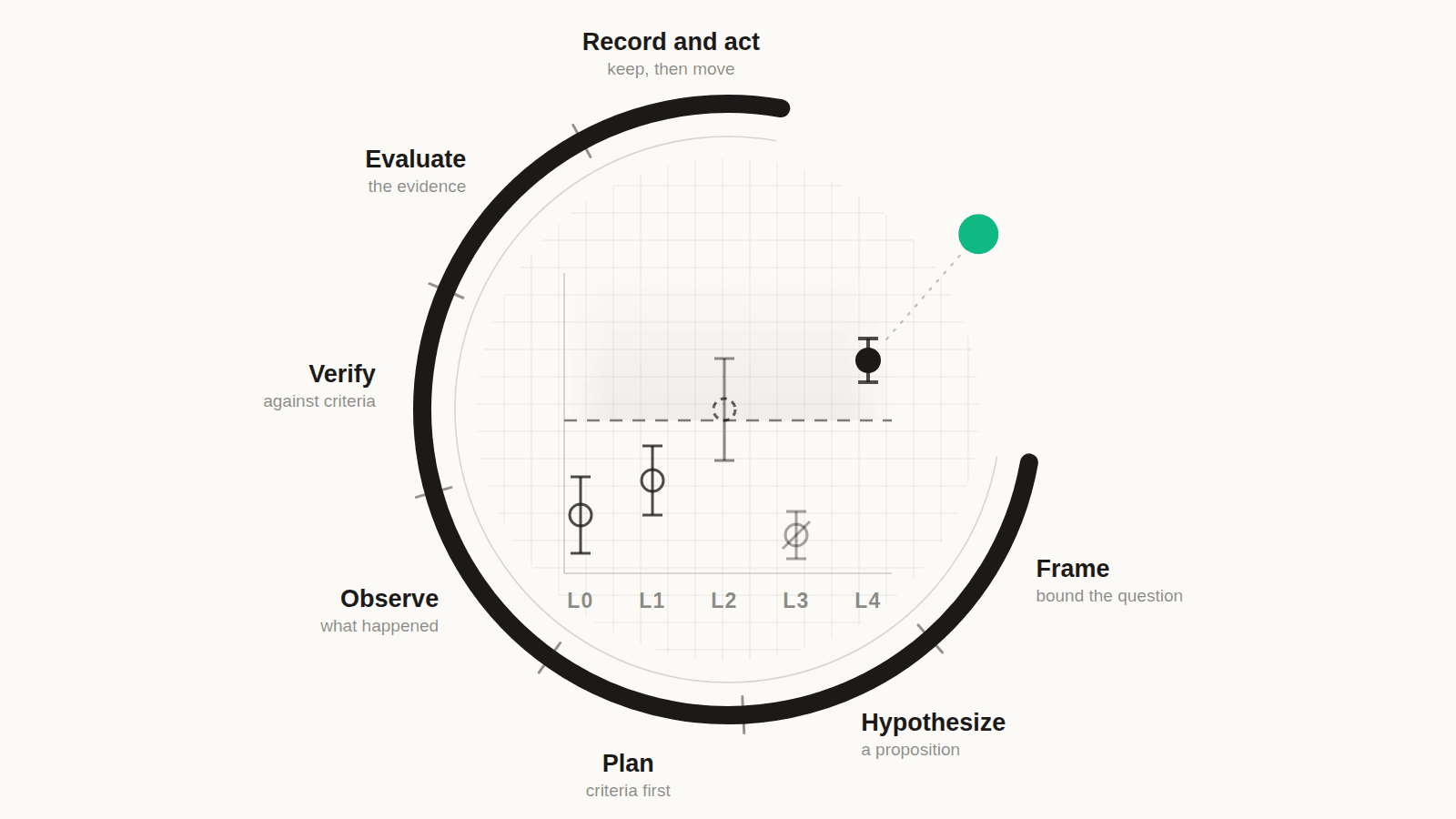
- Epistemic loop (how you get it) — a disciplined seven-stage path: frame, hypothesize, plan, observe, verify, evaluate, record. Every edge is tested by evidence and independent evaluation.
Other knowledge graphs pile up edges by extraction and assertion; here every edge has to be earned through the loop.
# Install (npm package, prebuilt — no build step, no allowBuilds prompt)
dsh plugin --profile web add clearai-dsh
Restart dsh web, then pick ClearAI in the preset picker at the top of a new session. That is the whole setup. Full install notes ↓
Left: the Epistemic Loop — seven stages. Its emerald fact dot is also the first node of the domain ontology on the right. Right: the ontology graph — dark is a concept, light is a value form, emerald an instance; the instance carries two contradictory assertions — the two readings are tinted amber, marking that they do not agree. The system reports the conflict; retracting or keeping is a human decision.
What you get: a domain ontology
A domain ontology that grows as you research:
- Vocabulary — the language your project speaks: concepts, predicates, value forms, units. Conventions themselves carry no truth value; sentences written with them do.
- Established entries — knowledge that passed the loop: each with its boundary, support level, and evidence chain. Each entry states its boundary explicitly, so it can be cited safely.
- Ontology graph and entity graph — what your domain looks like (structure), and what you have actually verified (the state of play).
- Conflict readings — contradictory conclusions surface automatically; the system reports them, and retracting or keeping is your decision.
How you get it: the Epistemic Loop
Most agent loops track one thing: whether the task is done. The Epistemic Loop also tracks what makes a conclusion trustworthy:
| Task loop | Epistemic loop | |
|---|---|---|
| Driving question | What next? | What do we know, and on what grounds? |
| Completion | The model declares it | The system computes it from delivered evidence |
| Verdict | Whoever did it, says so | Separated — above a level, the doer cannot judge themselves |
| Failure | Deleted, retried, forgotten | Kept: a refuted hypothesis is a result, not noise |
| What accumulates | A chat transcript | An ontology: every edge earned through the loop |
Inside the ring is the instrument's read-out: the L0–L4 axis, the pre-registered threshold as a dashed line, and five observations with error bars — the supported one filled, the inconclusive drawn as a dashed circle, the refuted left in place with a slash through it (nothing is deleted). The emerald dot at the opening is the one reading that crossed the threshold and settled as a fact.
…