diqierjia/StrataGate-AgentMemory
stratagate
stratagate is a community DeepSeek Harness plugin. Read the repository README before installing.
Install
npx @deepseek-ai/dsh plugin --profile web add stratagate-dshRestart `dsh web` after install. Bundle APIs can change during the developer preview.
README badge

[](https://dshhub.dev/plugins/stratagate-agentmemory)Paste this into your README. The star count updates with every catalog sync.
From the README
Excerpt from diqierjia/StrataGate-AgentMemory, cleaned of badges and images.
StrataGate
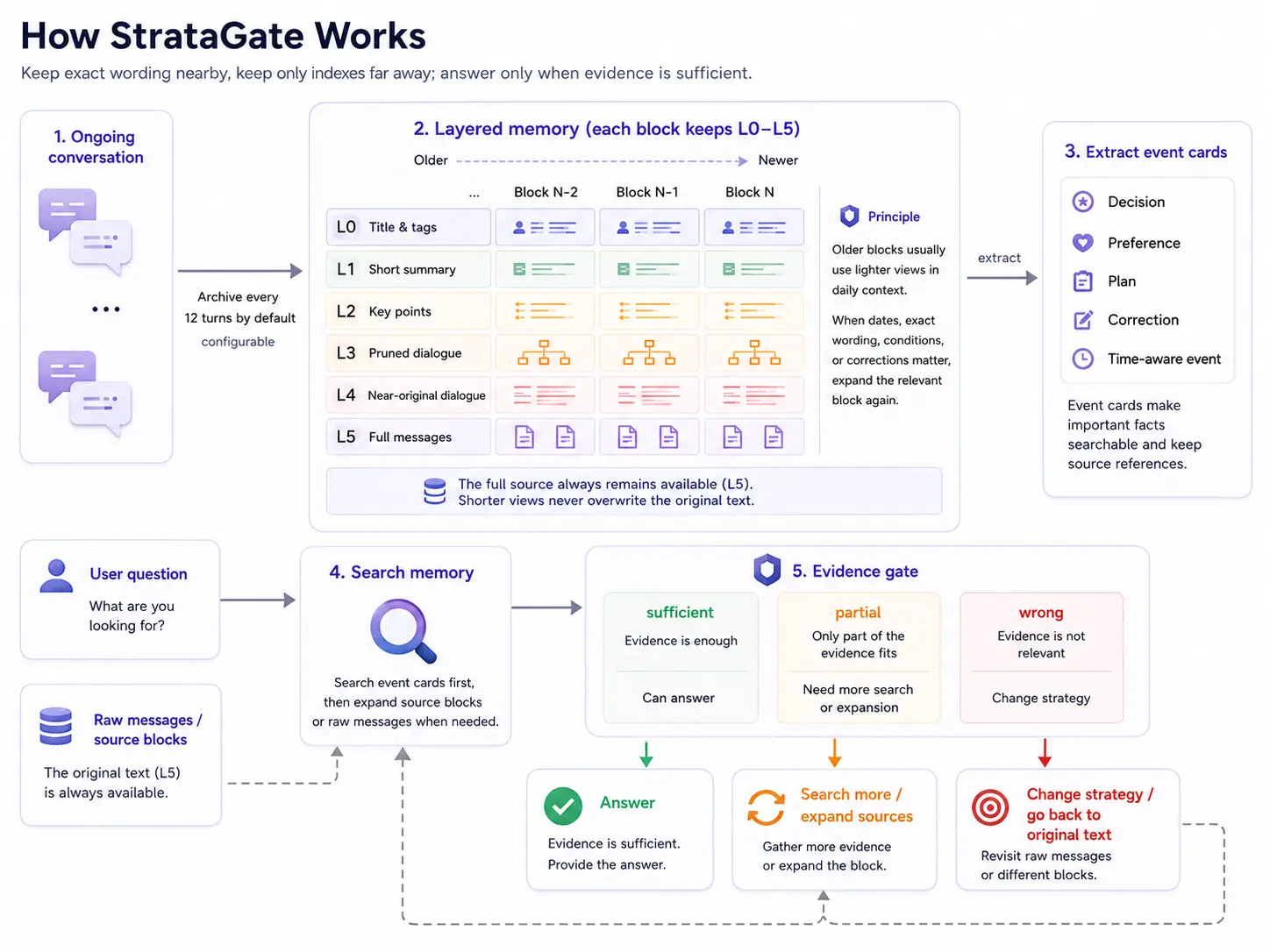
Keep recent conversations verbatim. Show older history as an index. Answer only when the evidence is sufficient.
A layered memory and evidence retrieval system for long-running AI agents.
中文说明 · Architecture · Full evaluation
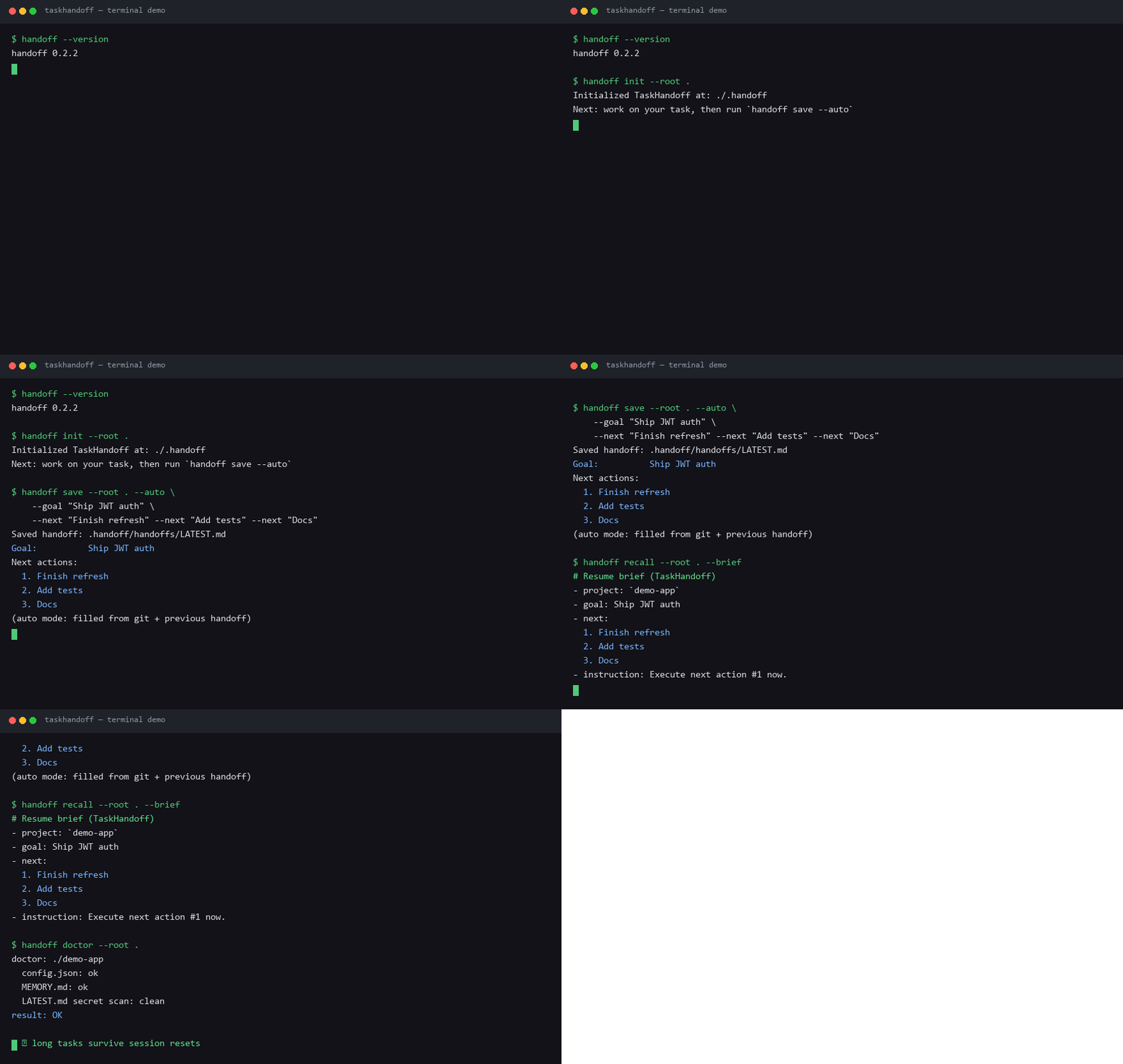
DeepSeek Harness plugin: automatic, local-first cross-session memory that remembers user preferences, project decisions, completed conversations, and tool results. It checks recalled evidence and can trace it back to the original messages before the agent answers. Install stratagate-dsh; implementation and usage details are in integrations/deepseek-harness.
LoCoMo conv-26: StrataGate averaged 80.46% accuracy across 10 independent Judge runs, versus 63.22% for Mem0 base (+17.24 percentage points)
Majority-correct: 121 / 152 vs 96 / 152 (+25 questions)
What problem does StrataGate solve?
A long-running agent needs more than a way to “store more.” When it answers, it must retrieve evidence that is correct, complete, and verifiable.
Keeping only summaries can lose dates, qualifications, and original wording. Similarity search can return related material that belongs to a different event. Treating every search hit as useful memory can also create a self-reinforcing retrieval loop.
StrataGate designs long-term memory around four core problems:
| Common problem | How StrataGate handles it |
|---|---|
| History keeps growing and no longer fits in context | Store conversations as L0–L5 layered views; older memories default to shallower levels |
| A summary omits a date, exact wording, or qualification | Preserve the L5 source messages permanently, so every derived memory can return to its source |
| Search finds related material, but not enough evidence to answer | Use an evidence gate to judge sufficiency; if evidence is incomplete, change strategy, expand an event, or inspect the source |
| Frequently retrieved results keep reinforcing themselves | Update long-term weight only for memories that the final answer actually uses |
StrataGate is not designed to make an agent retrieve more on every turn. It is designed to make the agent know whether the current evidence is sufficient and where to look next.
Experimental results
The current public comparison covers LoCoMo conv-26:
- 419 messages;
- 35 sessions;
- 152 category 1–4 questions;
- 10 independent Judge evaluations per question.
| Metric | StrataGate | Mem0 base | Difference |
|---|---|---|---|
| Mean accuracy across 10 Judge runs | 80.46% | 63.22% | +17.24 percentage points |
| Majority-correct | 121 / 152 (79.61%) | 96 / 152 (63.16%) | +25 questions |
| Temporal | 74.86% | 34.59% | +40.27 percentage points |
| Single-hop | 89.29% | 75.14% | +14.14 percentage points |
| Multi-hop | 66.56% | 61.56% | +5.00 percentage points |
| Open-domain | 83.08% | 84.62% | -1.54 percentage points |
The largest difference is in temporal questions. This is consistent with StrataGate's design—explicit event occurrence times, preserved source timestamps, and raw-source verification—but it is not a single-component ablation, so the full gap cannot be attributed to one field or retrieval step.
…