NOirBRight/dsh-llm-grok
dsh-llm-grok
Grok subscription OAuth provider and Web configuration plugin for DeepSeek Harness
Install
npx @deepseek-ai/dsh plugin --profile web add github:NOirBRight/dsh-llm-grok#v0.2.7Restart `dsh web` after install. Bundle APIs can change during the developer preview.
README badge

[](https://dshhub.dev/plugins/dsh-llm-grok)Paste this into your README. The star count updates with every catalog sync.
From the README
Excerpt from NOirBRight/dsh-llm-grok, cleaned of badges and images.
dsh-llm-grok
English | 中文
xAI Grok integration for DeepSeek Harness. This plugin is a separate provider route (grok) and settings namespace (llm-grok). It does not replace the built-in xai console API-key route, and it does not declare apiKeyEnv.
The package root exposes the Cordis plugin contract. The same artifact exports ./client, which contributes the Grok card under Settings → LLM Providers.
Installation
DeepSeek Harness 0.1.0-rc.6 or later is required. Install directly from GitHub:
dsh plugin --profile web add github:NOirBRight/dsh-llm-grok#v0.2.7
dsh web
The repository tracks release-ready lib artifacts, so GitHub installation needs no build-script allowlist. A source checkout can use a link installation after running pnpm run build.
Web configuration
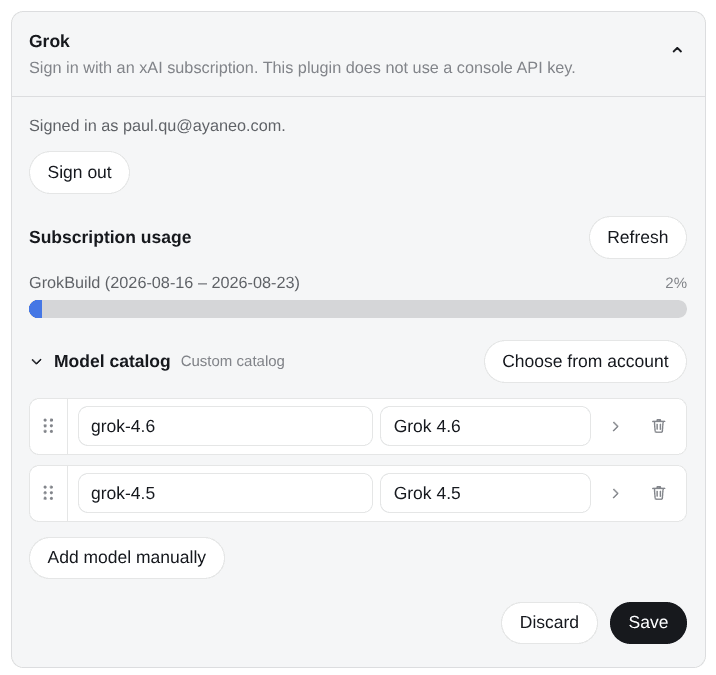
Open Settings → LLM Providers → Grok. Sign in with xAI starts a Host-owned PKCE flow against auth.x.ai (the Grok CLI public client), opens the system browser, and stores the session only on the Host at $DSH_HOME/grok-oauth.json (mode 0600). The card then shows the account email. Sign out deletes that file. The browser never receives tokens. This plugin does not read or write ~/.grok/auth.json.
Plugin configuration
The Plugin card keeps two catalogs: the signed-in account list from GET /v1/models-v2, and the displayed subset stored as settings.models. The conversation picker uses only the displayed subset. Each row can set Default thinking and a Context window used as the DSH compaction budget. Official grok-4.6 / grok-4.5 default to 500,000 tokens. The card catalog starts collapsed; it can be reordered, edited, deleted, or replaced from the account list. When the subset has never been saved, the frozen default is grok-4.6 and grok-4.5. Chat goes to POST https://cli-chat-proxy.grok.com/v1/responses. Every request includes DSH function tools plus always-on server-side { type: "web_search" } and { type: "x_search" }. Search is not a ctx.web provider. Server search returns encrypted tco_* reasoning items with empty summaries; those stay in replay and no longer each paint an empty Think row. If Grok also echoes the same search as a client custom_tool_call (xs_call-* / ws_call-*, often named x_keyword_search), the plugin drops it so DSH does not report unknown tool. Reasoning is sent as official Responses reasoning: { effort }, with values low / medium / high (default) / xhigh (4.6 only). When signed in, the card also shows subscription usage from a Host billing read (GET /v1/billing?format=credits). Logged-out cards do not request billing; an unrecognized surface is shown as unsupported, not as an error.
Optional grok_image_gen (default off) registers a model-facing tool that generates an image with Grok Imagine. It reuses the same Host OAuth session and posts https://api.x.ai/v1/images/generations — the same rail Grok Build's local image_gen uses, not a console API key and not the chat proxy. The name is distinct from Codex codex_generate_image. Generated bytes are saved to the workspace and committed through the attachment store.
Chat without a session fails MISSING_CREDENTIAL. A stored session whose refresh fails is cleared and fails AUTH. ensureFreshSession already runs before each chat request; a later 401 is not retried at the Responses layer.
…