hezhongtang/dsh-capability-optimizer
dsh-capability-optimizer
dsh-capability-optimizer is a community DeepSeek Harness plugin. Read the repository README before installing.
Install
npx @deepseek-ai/dsh plugin --profile web add dsh-capability-optimizerRestart `dsh web` after install. Bundle APIs can change during the developer preview.
README badge

[](https://dshhub.dev/plugins/dsh-capability-optimizer)Paste this into your README. The star count updates with every catalog sync.
From the README
Excerpt from hezhongtang/dsh-capability-optimizer, cleaned of badges and images.
dsh-capability-optimizer
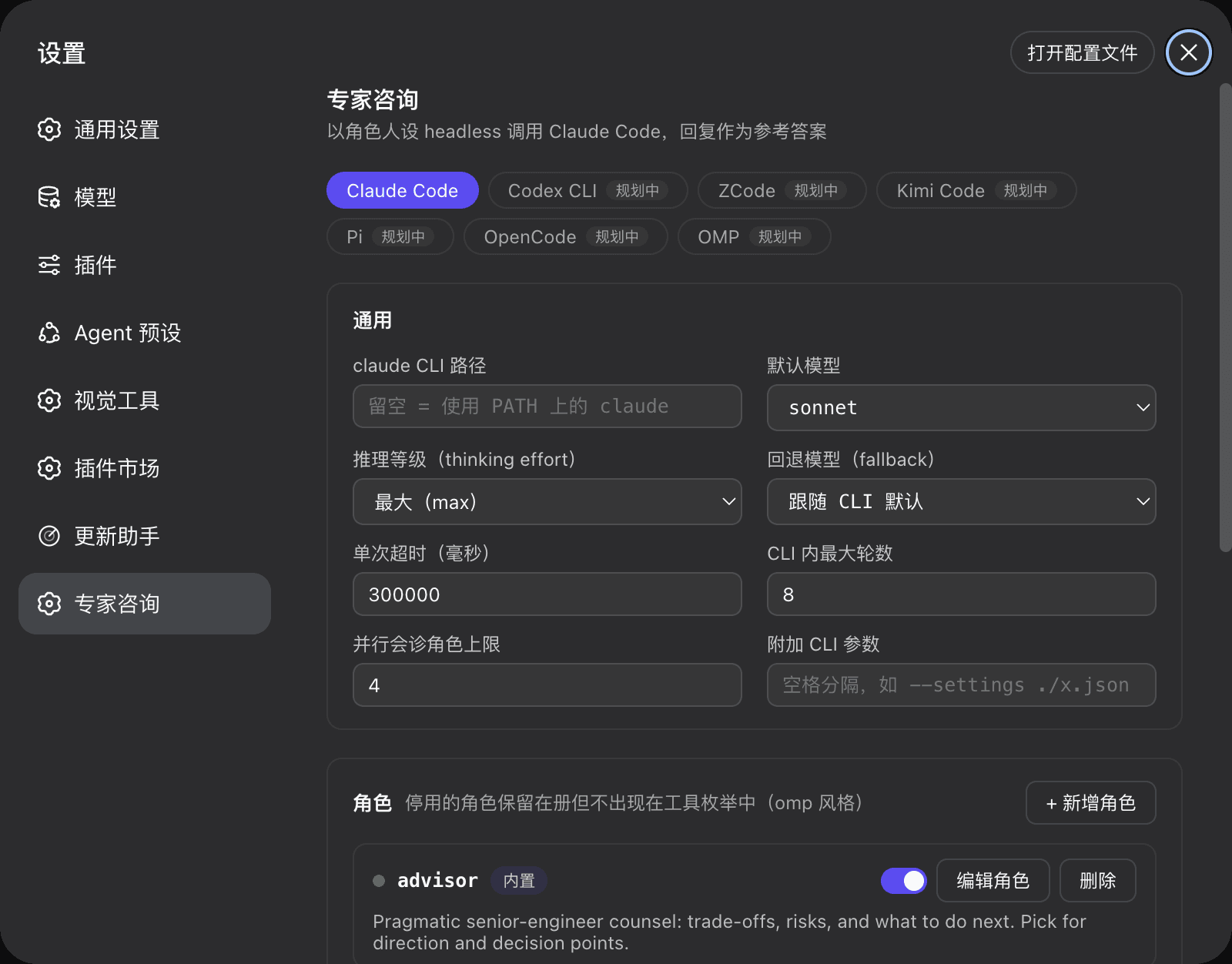
External-expert consultation for DeepSeek Harness: the agent headlessly invokes the Claude Code CLI through explicit advisor, reviewer, designer, or custom role contracts, then weighs the structured replies as reference answers.
English | 中文
Why this exists
A single harness has one perspective. At a consequential decision, before declaring risky work done, or before significant new code, a second model can supply useful independent evidence. That is a hypothesis to measure, not a guaranteed quality gain: persona research does not show that merely calling a model an expert reliably improves accuracy. This plugin makes consultation a bounded tool call instead of a copy-paste detour. Claude answers under a behavioral and output contract, and DSH receives the result as advice to weigh, not obey.
Phase 1 speaks only to the Claude Code CLI. The settings schema (v2, one workspace per harness), the UI tab catalog, and the runner seam are already multi-backend: codex, zcode, kimi-code, pi, opencode, and omp each land later as a runner behind the same three tools.
Features
| 🎭 Role contracts | Built-in advisor / reviewer / designer with different objectives and JSON contracts, or your own (outputKind, prompt, model, fallback, effort). enabled parks a role without deleting it |
| 🧠 Thinking effort | Native --effort (low / medium / high / xhigh / max) at three levels: per-call argument > role > global default |
| 🔄 Model fallback | One-hop retry on model-level errors (unrecognized_model, model-not-found, …) with usedFallback recorded in run metadata |
| 🤖 Agent tools | consult_expert (one role, one question) · consult_panel (up to N roles in parallel, one wall-clock wait) · consult_roles (live roster) |
| 🎛 Auto consult | Composer-seat toggle (permissions row) picks roles per session; a policy section rides the system prompt and lifecycle nudges fire at write/finish anchors, budgeted per role per session |
| 🖥 Settings workspace | One tab per harness CLI; saves hot-apply — role edits reach the agent's next model step without a dsh restart |
| 🔬 Connectivity test | One real consultation end-to-end (CLI + login + proxy) with turns, duration, cost, and fallback marker |
| 🛡 Defense in depth | Read-only CLI tools, strict MCP isolation when supported, permission pinning, typed schemas, bounded output/turns/time, and explicit untrusted-evidence labels |
| 🌐 Fully bilingual | Every UI string — including built-in role descriptions, reserved-backend notes, and validation messages — follows the UI language (zh/en); agent tooling keeps stable English identifiers |
Install
# from npm (recommended)
dsh plugin --profile web add dsh-capability-optimizer

# or straight from the GitHub repo
dsh plugin --profile web add github:hezhongtang/dsh-capability-optimizer
Restart dsh web (or your profile of choice). Works in any profile — web, tui, headless — because the tools are host-side agent tools.
Requirements: the claude CLI (npm i -g @anthropic-ai/claude-code) on PATH, logged in.
Usage
Ask your agent:
"consult the reviewer on this diff before we call it done"
…